Young people’s confidence in the future has recently been discussed in increasingly negative terms. In Finland and other Nordic countries, young people’s faith in their future has been shaken by a range of local and global crises. Individualism, climate change, pandemics, political crises, and experiences of intergenerational injustice all influence how young people perceive their own future and the future we share (Appelqvist-Schmidlechner et al., 2026). In this text, however, I will focus on pensions, as they largely determine when and in what condition our generation will finally get to sit in a rocking chair and comment on the behaviour of young people.
Pensions are, as the cliché goes, a social contract between generations. A large proportion of the earnings-related pension contributions we pay goes towards financing the pensions of current retirees. At its best, the system works when there are plenty of employed people contributing to it and relatively few pensioners receiving benefits. In 1970, there were 700,000 pension recipients, and the earnings-related pension contribution amounted to 5% of wages (Gröhn, 2008, p. 28, Figure 14). At the end of 2025, nearly 1.6 million people were receiving earnings-related pensions, while the contribution rate stood at approximately 24.40% of wages (Finnish Centre for Pensions). There are more pension recipients, and proportionally fewer people contributing to the system.
the numbers and hips dont lie. We are currently paying substantial pension contributions to finance existing pensions, believing, hoping, and perhaps praying just a little that the system will still work when it is our turn to retire. At the same time, shrinking younger generations and other crises have raised questions about the system’s sustainability. People have all kinds of ideas about how to fix it: increasing immigration, encouraging people to have more children, or holding our breath until natural population decline somehow corrects our demographic structure. Others would rather dismantle the system altogether and leave everyone responsible for their own retirement security through investment funds.
The retirement age has been rising steadily for several reasons, including the need to ensure the system’s sustainability and increasing life expectancy among pensioners. Now, officials at the Ministry of Finance would like to accelerate this trend by raising the minimum old-age retirement age to 70 from 2032 onwards, as reported by Toivonen, Koponen and Hara (2026). The aim is to extend working careers and thereby delay retirement, while also increasing pension contributions. However, I hope that decision-makers will pay attention to people’s ability to cope at work, workplace ergonomics, and individual arrangements so that we can realistically remain in working life and stay well throughout our careers. We lose a substantial number of working years due to burnout, mental health challenges, and other problems that structural measures could help prevent. We must invest in helping young people enter working life, as unstable labour markets, the growing prevalence of short-term jobs, and employment through temporary work agencies have fragmented our labour market.
Nevertheless, I do not want to place too much blame on previous generations. They, too, made decisions in the world they lived in and experienced various crises, unemployment, recessions, and global conflicts. They built this country after it gained independence, and I am grateful to them for that. Many pensioners also live on low incomes, and I do not believe it would be humane or sensible to cut their means of subsistence. However, I believe that each of us must contribute to this collective effort in one way or another if we want the system to deliver on its promise from one generation to the next.
In this respect, the message of SAMOK’s political programme is clear. Intergenerational justice must be a guiding principle running through all future pension reforms. We live in a constantly changing world where we do not know what will happen next week. We must adapt to our changing environment, take a longer-term approach to policymaking than a single government term, ensure that young people are heard in decision-making, and pursue bold policies with our hair blowing in the wind.
I want to stand up for students, young people, and future generations. This is one of the reasons why I am running for a position on SAMOK’s Board for 2027.
Lähteet:
Appelqvist-Schmidlechner, K., Axelin, H., Helenius, J., Jahnukainen, M., Kallio, J., Kiilakoski, T., Kiiski, A., Kivinen, R., Kurki, M., Palomäki, J., Pihkala, P., Puura, S. & Tähkäpää, O. 2026. Nuorten tulevaisuususko horjuu – millaisia toimia nyt tarvitaan? Opetus- ja kulttuuriministeriön asiantuntijaryhmän loppuraportti. Opetus- ja kulttuuriministeriön julkaisuja 2026:18. Helsinki: Opetus- ja kulttuuriministeriö. https://urn.fi/URN:ISBN:978-952-415-084-2
Gröhn, J. 2008. Lakisääteisen eläkejärjestelmän etuudet ja rahoitus iän mukaan ja sukupolvittain. Eläketurvakeskuksen keskustelualoitteita 2008:1. Helsinki: Eläketurvakeskus. https://www.julkari.fi/server/api/core/bitstreams/a990dd4e-bfe8-41cd-8ddb-60f6d1def5d6/content
Eläketurvakeskus. Ei vuosilukua. Suomen työeläkkeensaajat. Viitattu 18.10.2026. https://www.etk.fi/tutkimus-tilastot-ja-ennusteet/tilastot/elakkeensaajat-ja-elakemenot/suomen-tyoelakkeensaajat/
Toivonen, T., Koponen, J. & Hara, J. 2026. Oppositiosta torjutaan ehdotus eläkeiän nostosta 70:een – Lindtman: Erittäin kova esitys viisikymppisille. Yle, 7.10.2026. https://yle.fi/a/74-20250210
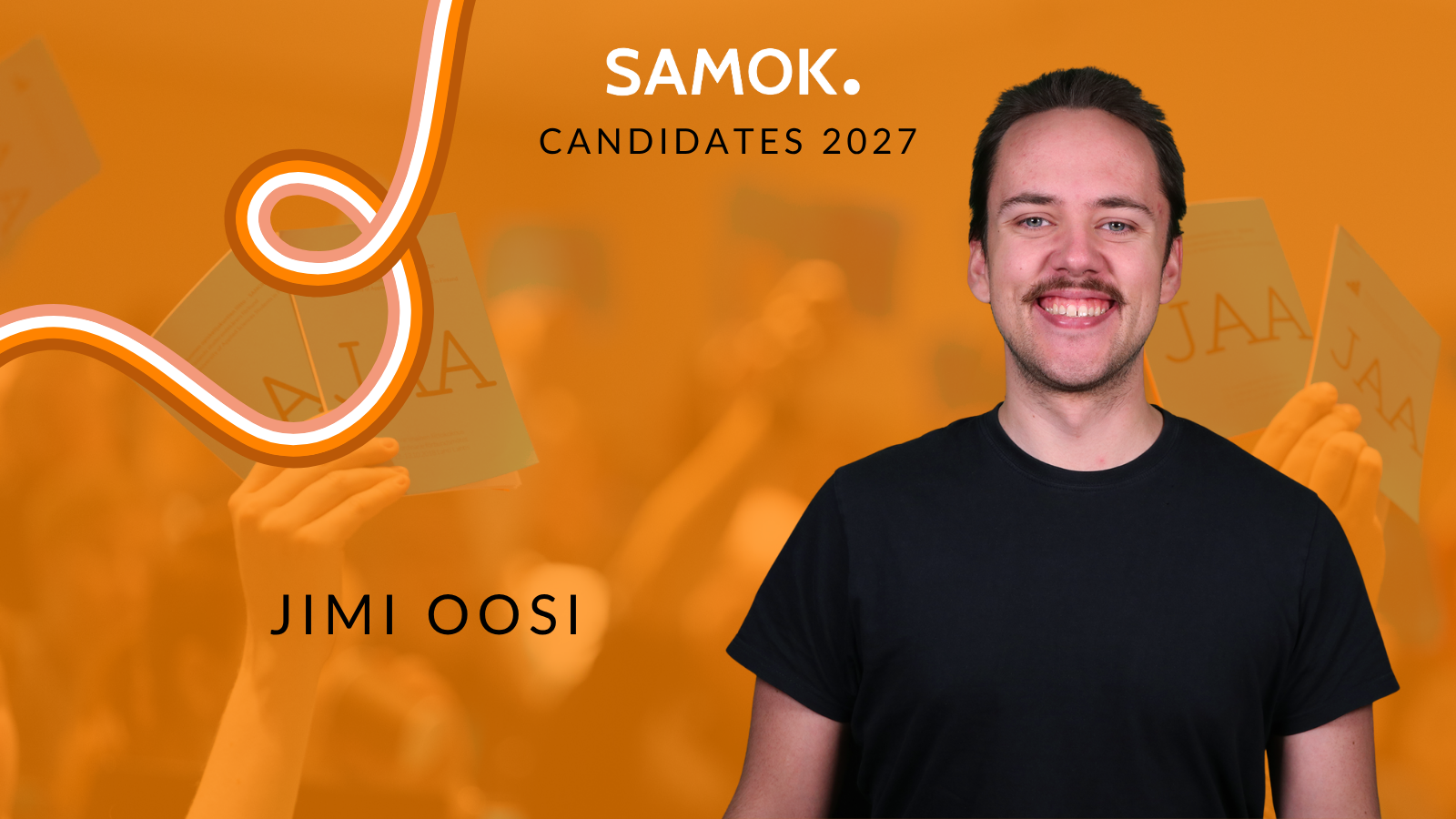
Author: Jimi Oosi, candidate for SAMOK board for 2027.
During the autumn, candidates for the SAMOK Board of Directors for 2027 will be presented on the SAMOK blog and on social media. For more information about the General Assembly, click here.