As elections approach, the same question always comes up: Why don’t young people vote?
But are we looking at the issue from the wrong angle when we ask what young people should be doing more of? We rarely stop to consider what society, organizations, political parties or our student movement should be doing more of.
Young people are sometimes accused of being passive. Supposedly, they aren’t interested. In reality, young people’s interest in politics is higher than it has been in decades (Youth Barometer 2025). An increasing number of young people also believe in traditional means of influence. However, the voter turnout for this age group in the last parliamentary elections was approximately 58 % (Parliamentary Elections 2023, Analysis of voters’ backgrounds). Thus, the real question is: how do we ensure that this interest translates into participation?
The largest age group among students at Universities of Applied sciences is 18–24-year-olds (Vipunen, the National Agency for Education’s statistical service). This age group includes students for whom next year’s parliamentary elections may be their first opportunity to vote. This is when they begin to build their own relationship with society and the decision-making process. They make their first major decisions about where to study, their field of study, their livelihood, housing, and working life. It is therefore extremely important to bring these topics closer to young people and their lives. If the impact of decision-making on one’s own life remains unclear, or if one’s own influence feels minimal, the barrier to participation grows.
In politics, attention is easily drawn to groups that actively make their voices heard. If participation among young people and students remains low, there is a risk that their issues will also be sidelined. Voter turnout, therefore, is not just a matter of truly representing the people, but also a matter of generational politics. Who will ensure that decisions in the coming decades take into account high-quality education, student well-being, responsible international engagement, and opportunities for young people?
In 2019, SAMOK published a report titled “To Vote or Not to Vote?”, which found that the most common reason University of Applied sciences students gave for not voting was the difficulty in finding a suitable candidate. Other significant reasons included the feeling that they didn’t have enough of their own opinions and a lack of faith in the impact of voting. So this doesn’t sound like passivity or indifference. It is clear that a distance has emerged between politics and young people, which raises the barrier to participation. Student unions are needed precisely to lower this barrier.
For many young students, the student body is the place where democracy becomes a tangible reality for the first time. There are representative council elections, student representatives, position statements, opinion pieces, as well as meetings, steering committees, and advocacy work. Students can influence matters that affect them all, and they are encouraged to do so. At its best, student unions build confidence that one’s own participation matters. When a student first experiences the feeling of being heard within their own higher education community, it becomes easier to believe that their voice also makes a difference in the city, the welfare region, or in parliamentary elections.
A parliamentary election year is a significant opportunity to change course and strengthen youth participation. Student unions are already doing valuable work, but I believe SAMOK could serve as a unifying force at the national level. In practice:
- ready-made communication packages for student unions
- easy-to-use social media materials
- templates for election panels
- training for student representatives
- joint national election campaigns
- joint workshops to share best practices among student unions
- collaboration with election authorities to ensure that early voting locations are as close as possible to students’ daily lives
- strengthening collaboration with stakeholders, such as youth councils and other influential organizations
Research and experience show that raising awareness, holding election events, and making it easy to vote all support youth participation.
I hope for a more equitable generational policy. During this government term, the focus has been on making policies for the older generation, which is important in itself, but it must not be done at the expense of young people and students. Now is the time to talk about young people’s faith in the future and to invest in their well-being and opportunities to have a say. If we do not invest in them now, it will have long-lasting consequences for the well-being of future generations. It is time to break this cycle and take young people and students – the builders of the future – into account in the upcoming government program.
Sources:
Opetushallinnon tilastopalvelu Vipunen. (20.9.2026). https://vipunen.fi/fi-fi/_layouts/15/WopiFrame.aspx?sourcedoc=%7B96141BDC-23B9-4426-BED3-169FF9CD28E7%7D&file=Korkeakoulutuksen%20opiskelijat_A2.xlsb&action=default
Penttilä, J. (2019). AMK-opiskelijoiden arvot & asenteet – Äänestämään vai ei? Suomen opiskelijakuntien liitto SAMOK. Retrieved 6.10.2026. https://samok.fi/wp-content/uploads/2019/03/arvotasenteet_a4_netti.pdf
Statistics Finland. (14.4.2023). Parliamentary Elections 2023, Result of the control calculation. Retrieved 6.10.2026. https://stat.fi/en/publication/cl8lkinf9pwt30cvz5uvtgprk
Statistics Finland. (19.5.2025). Parliamentary Elections 2023: background analysis of voters. Retrieved 6.10.2026. https://stat.fi/en/publication/cl8mvt1xt143o0cvzel1m7esx
The National Youth Council, the Finnish Youth Research Society, and the Ministry of Education and Culture. (2025). Youth Barometer 2025. Retrieved 6.10.2026. https://tietoanuorista.fi/wp-content/uploads/2026/03/nuorisobarometri-2025_EN.pdf
Wass, H., and Helimäki, T. (6.3.2023). A voices about voting. The Finnish National Election Study Consortium (FNES). Retrieved 6.10.2026. https://www.vaalitutkimus.fi/en/a-voice-about-voting/
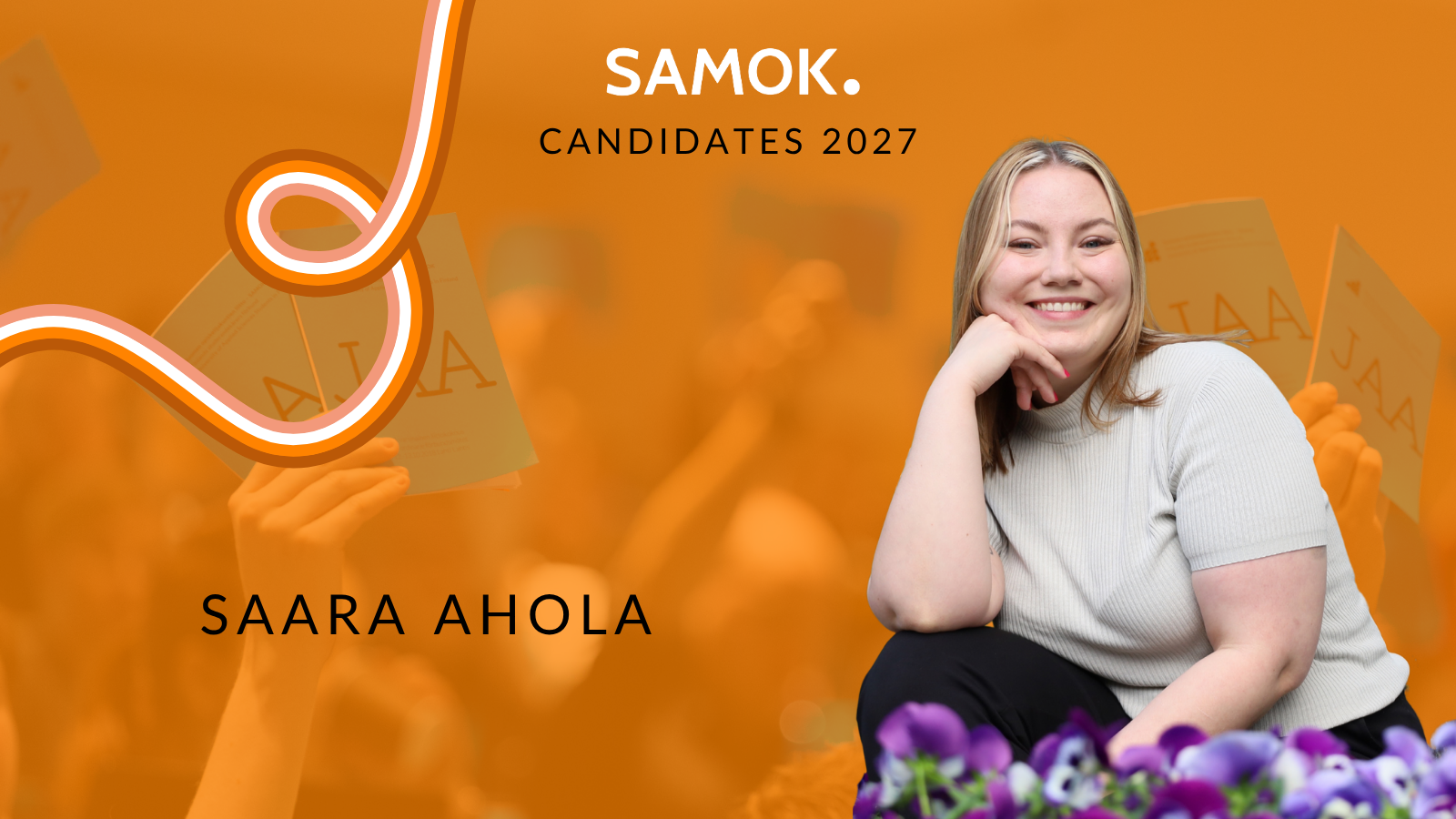
Author: Saara Ahola, candidate for SAMOK president for 2027.
During the autumn, candidates for the SAMOK Board of Directors for 2027 will be presented on the SAMOK blog and on social media. For more information about the General Assembly, click here.